
Blockbuster Wasn’t Killed by Netflix
A billion dollars in debt, placed on Blockbuster’s balance sheet before the competitive battle began, made every response structurally unaffordable.

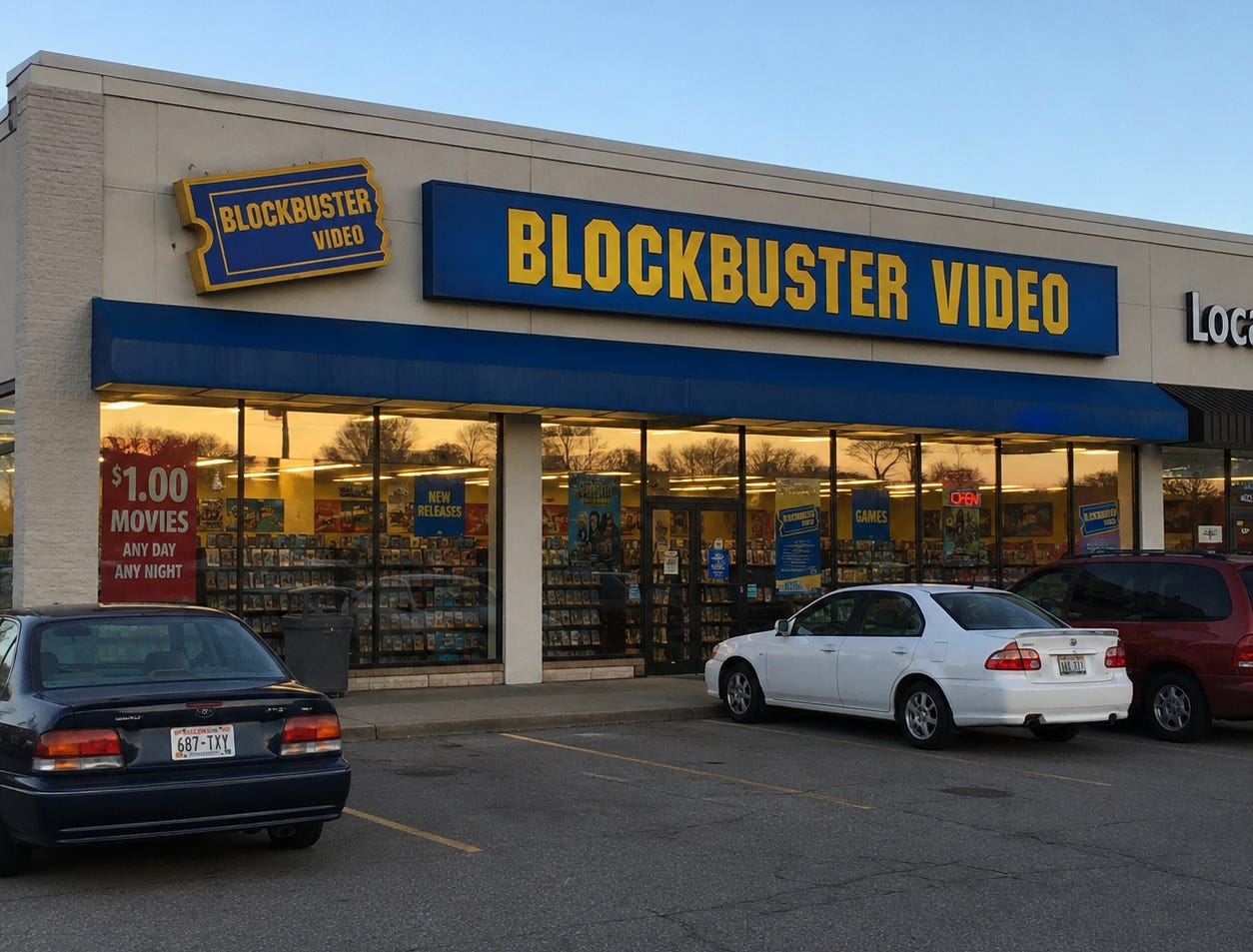
There is a version of the Blockbuster story that most people know. A company that dominated home video rental for two decades, failed to see what Netflix represented, and declined steadily until there was nothing left. The story is tidy. It fits a familiar pattern — the incumbent that couldn’t adapt, the disruptor that moved faster, the market that rendered a business model obsolete. It is also, in its most important detail, wrong.
Blockbuster saw Netflix. It understood the threat specifically and early. By late 2006 it had built a direct competitive response — a hybrid rental model that combined online convenience with physical store access — that caused Netflix’s subscriber growth to measurably slow. Netflix acknowledged the threat in its own filings. The program was working.
It was pulled apart before it could finish the job. Not because leadership changed its mind about the strategy. Not because customers stopped responding. Because the capital required to sustain it had already been committed elsewhere — to a debt obligation placed on Blockbuster’s balance sheet at the 2004 Viacom spinoff, before the competitive battle had fully begun.
What follows is not a story about a company that failed to adapt. It is a story about a company that adapted, found a response that worked, and ran out of the financial runway required to see it through.
The System
Blockbuster’s model at its peak was built on a simple competitive logic: physical scarcity, resolved at scale. A customer who wanted a specific movie on a Friday night in 1995 had limited options. Blockbuster had spent a decade building the infrastructure to be the reliable answer to that problem — wide store coverage, computerized inventory tracking, broad title selection, and a family-oriented environment that mass-market consumers trusted.
By the end of 2004, the company operated approximately 9,100 stores across the United States and 24 other countries. Total revenues for 2004 were $6.1 billion. The domestic rental market represented roughly $8 billion in annual consumer spending that year. Blockbuster’s share of that market was substantial and defensible — or appeared to be.
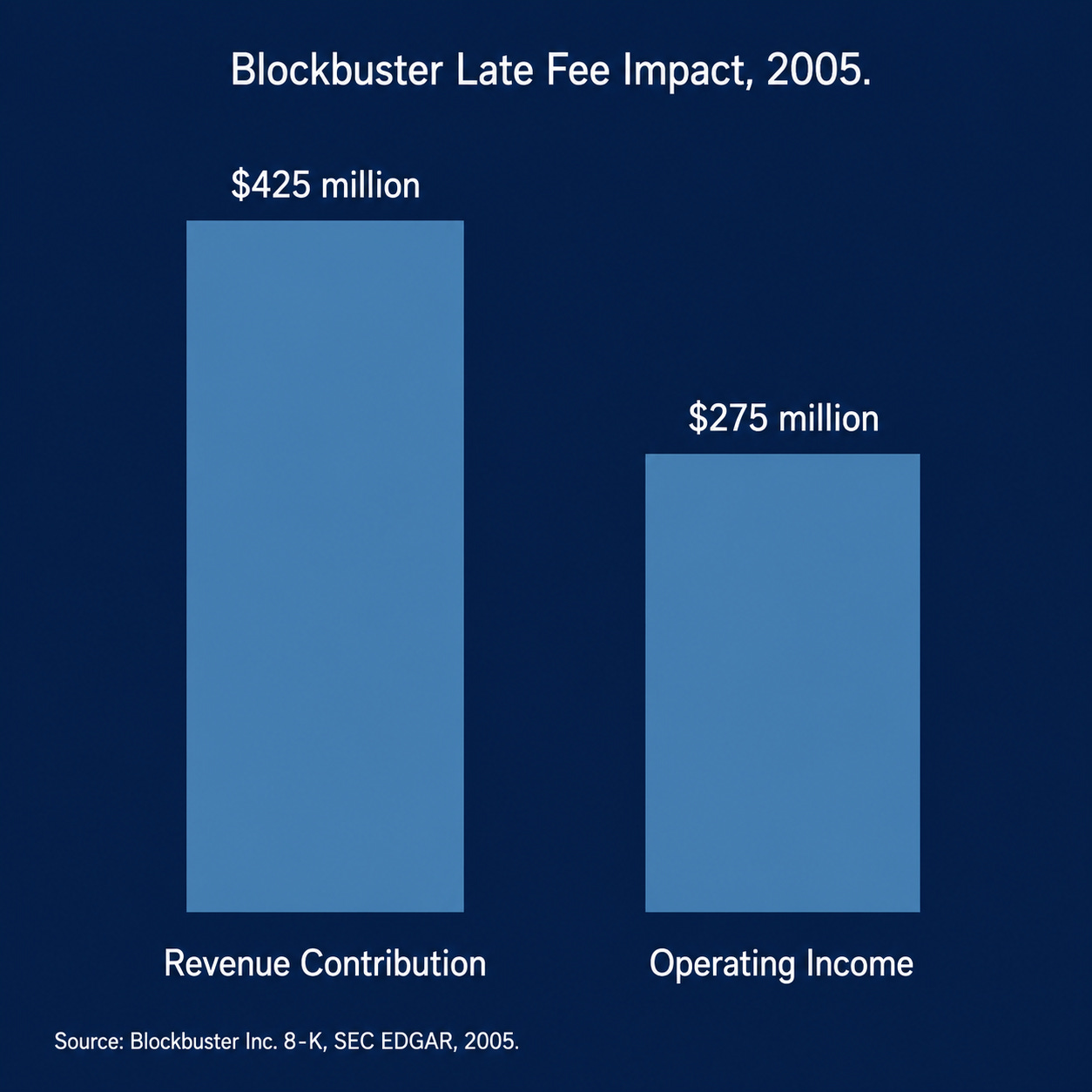
The model had a structural feature that would later become its most visible liability. Late fees — extended viewing fees in the company’s formal language — were not an incidental revenue line. They were embedded in the economic logic of a system built around high-demand titles with limited copy depth. When a popular new release sat unreturned past its due date, it was unavailable to the next customer. The fee was the mechanism that cleared inventory back into circulation. The revenue it generated — estimated at $400 to $450 million annually in the company’s own disclosures — funded a material portion of the operating income that supported the store network’s cost base.
The model required one condition to function as designed: that physical presence remained the primary mechanism through which consumers accessed home video. As long as that condition held, the store network was a genuine competitive asset. Title availability, store proximity, and the browsing experience were things a mail-order service could not replicate. The density of the network was the business.
That condition had held for nearly twenty years. By 2004, it was no longer guaranteed.
The Shift
Netflix launched its DVD-by-mail subscription service in 1998. The founding narrative of the company — that its CEO Reed Hastings had been charged a late fee on an overdue rental and decided to build an alternative — was pointed directly at Blockbuster’s most resented feature. The model Netflix offered was structurally different from anything in the physical rental market: a monthly subscription, no due dates, no late fees, a catalog far larger than any store could stock, delivered by mail.
What Netflix demonstrated over the following years was not simply that consumers would use a mail subscription service. It demonstrated something more significant: that a meaningful segment of consumers would accept a delay in exchange for eliminating the friction that late fees, store trips, and limited selection created. Physical presence was not a prerequisite for the rental transaction. Convenience could be redefined.
By 2004 this was no longer a hypothesis. Netflix had over one million subscribers. The domestic rental market was declining — from approximately $8.2 billion in 2003 to an estimated $8.0 billion in 2004, with projections showing continued contraction through the decade. Blockbuster’s own 2004 annual report acknowledged that its core rental business had continued to decline during the year.
The condition the Blockbuster model required — that physical access remained primary — was no longer guaranteed. The shift had already happened. The question was what Blockbuster could do about it, and what it had available to do it with.
The answer to the second question had been determined months earlier, in a transaction Blockbuster did not choose.
The Response
In October 2004, Viacom completed the spinoff of Blockbuster as an independent publicly traded company. Viacom had owned a controlling stake in Blockbuster since 1994, acquiring it primarily to help finance the Paramount Pictures acquisition. For a decade, Blockbuster had operated as a subsidiary within a larger media conglomerate, its capital allocation subordinated to parent company priorities.
The spinoff structure placed approximately $1 billion in senior subordinated notes — high-interest debt instruments due in 2012 — on Blockbuster’s balance sheet at separation. This was the capital structure within which every subsequent decision would have to operate.
Blockbuster’s response to the Netflix threat unfolded in two moves, both of which were rational given what management understood at the time.
The first was the elimination of late fees. Effective January 1, 2005, Blockbuster ended extended viewing fees at all company-operated domestic stores. Chairman and CEO John Antioco described it as the biggest customer benefit in the company’s history. The competitive logic was sound: late fee resentment was the most documented driver of customer attrition to Netflix. Removing it addressed the most visible competitive disadvantage directly.
The financial consequence was immediate. In the company’s own words, extended viewing fees had contributed $400 to $450 million in revenues and $250 to $300 million in operating income the prior year. That income was gone. The cost base built around its presence was not.
The second move came in late 2006. Blockbuster Total Access launched as a hybrid rental model that allowed online subscribers to return DVDs by mail or exchange them at a participating Blockbuster store for free in-store rentals. It was a direct competitive response to Netflix built around the one structural advantage Netflix could not replicate: a physical store network already in place. The program combined Netflix’s convenience with a capability Netflix structurally lacked.
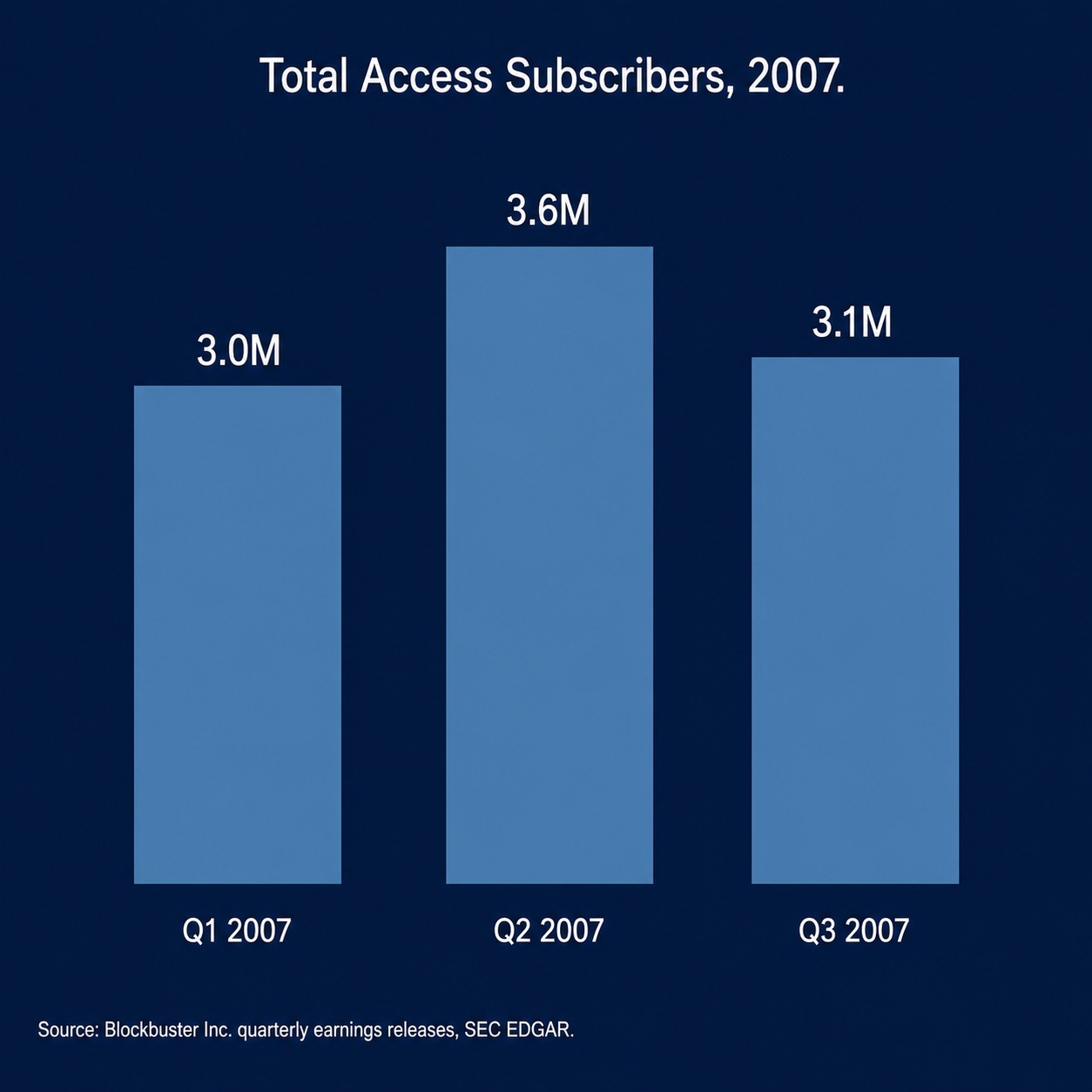
The competitive effect was real and measurable. By the end of 2006, Blockbuster had added approximately 700,000 online subscribers in a single quarter. By Q1 2007, Antioco reported that Total Access had exceeded 3 million subscribers and that the first quarter of 2007 had been the company’s highest subscriber growth quarter ever. Netflix noticed. In its own FY2007 annual filing, Netflix stated directly that its slowing growth appeared primarily to be the result of the rapid growth of Blockbuster Online.
Total Access was working. And it was expensive.
Each in-store exchange — the feature that differentiated Total Access from Netflix — cost Blockbuster more than the subscription revenue it generated at competitive pricing. The subsidy was the mechanism of competitive traction. The program’s success at attracting subscribers made the aggregate subsidy cost larger with each passing quarter. By Q2 2007, with the subscriber base at 3.6 million, newly appointed chairman and CEO Jim Keyes stated directly that “the costs associated with the program affected our profitability” and that modifications were planned before year end.
The modifications were rational from a near-term financial perspective. The debt service obligation was fixed. The operating losses were widening. The board pressure — from Carl Icahn, who had acquired a significant stake and pushed consistently for cost reduction over competitive investment — was real. Reducing the per-exchange subsidy and pulling back marketing spend on Total Access improved the near-term P&L. It also removed the program’s competitive effectiveness at the moment Netflix was most vulnerable to it.
Netflix’s own filing acknowledged what followed: Blockbuster’s pricing changes contributed to an acceleration in Netflix’s subscriber growth resuming.
The strategic response was not a failure of vision. It was a response that worked until the capital structure made sustaining it impossible.
The Constraint Layer
Five constraints were compounding simultaneously by 2007. None was solvable without addressing the others. Together they formed a set that closed off the available options faster than any single response could open them.
The debt service obligation. The $1 billion in senior subordinated notes issued at the 2004 Viacom spinoff carried a fixed annual cash obligation regardless of operating performance. In a business generating sufficient free cash flow, this would have been manageable. Blockbuster was simultaneously absorbing the late fee revenue loss, investing in Total Access subscriber acquisition, and closing underperforming stores — all of which consumed cash. The debt service was senior to all of it. Every dollar committed to interest payments was a dollar unavailable for competitive investment.
The late fee revenue gap. The $250 to $300 million in operating income that late fees had contributed was gone. The cost base — store leases, labor, title acquisition — had been calibrated to its presence. Eliminating late fees was competitively necessary. Absorbing the loss without a corresponding reduction in costs created a structural gap that the balance sheet had to bridge at the same time it was funding debt service and Total Access investment. The three draws on available capital were simultaneous and non-negotiable.
The store lease portfolio. At peak, Blockbuster operated more than 9,000 locations globally. Lease obligations are multi-year commitments that cannot be exited without cost. As revenue declined and store traffic shifted to online channels, locations that had been marginally profitable became loss-generating — but the lease obligations continued on their original terms. Store closure programs reduced the count over time, but the pace of closure required to materially reduce the fixed cost base would have triggered restructuring costs the balance sheet could not absorb.
The Total Access subsidy constraint. The program that was winning subscribers was doing so at a per-unit cost that required capital to sustain. The board intervention that restructured Total Access pricing in the second half of 2007 reduced the subsidy and with it the program’s competitive draw. By Q3 2007 the subscriber base had declined to 3.1 million from the Q2 peak of 3.6 million. The company announced it would no longer report online subscriber counts going forward, framing the shift as a broader focus on total membership rather than the online channel specifically. Netflix’s growth resumed.
The franchise network misalignment. Blockbuster’s domestic store base was not entirely company-operated. As of late 2005, approximately 1,079 of the 5,696 domestic stores operating under the Blockbuster brand were franchise locations. The no-late-fee program, when implemented at the start of 2005, was adopted at all company-operated stores. Approximately 475 franchise stores were participating as of Q3 2005 — fewer than half. The franchise stores that did not participate were operating under a different economic model, one in which late fees remained a revenue component their unit economics depended on. Whether those franchisees could have sustained a full transition to the Total Access model — with its in-store exchange costs layered on top of the late fee elimination — is not directly documented. What the participation data shows is that the store network Blockbuster’s hybrid model depended on was not fully available for that model’s execution. The competitive differentiator that made Total Access superior to Netflix was a physical network that, in practice, was operating under at least two different economic arrangements simultaneously.
A third competitor had also entered during this period. Redbox had begun placing low-cost DVD rental kiosks at grocery stores and fast food locations, introducing price-based competition that the in-store rental model had not previously faced. This added a second front to the competitive pressure at the same time the balance sheet had no capacity to respond to the first.
The five constraints did not operate independently. The debt service consumed capital the Total Access subsidy required. The late fee gap widened the operating losses the debt service was already straining. The lease obligations created a fixed cost floor that could not be reduced quickly enough as revenue declined. The franchise misalignment created execution gaps in the network the hybrid model needed. Each constraint made the others harder to address. The window in which any single intervention might have been sufficient was already closing before the competitive response was fully deployed.
The Compression
By 2008 the option set had become structurally binding. The actions required to escape the constraints each required resources the constraints themselves had already consumed.
Sustaining Total Access at competitive pricing required ongoing per-exchange subsidy capital. The debt service had consumed it. Reducing the fixed cost base required lease termination payments and restructuring costs. The operating losses had consumed the liquidity those payments required. Investing in streaming — the next competitive arena Netflix was already positioning for, having introduced its instant-watching feature in January 2007 — required technology infrastructure and content licensing capital. Neither was available. Refinancing the debt on terms that would restore operational flexibility required a credible growth story. The competitive position, following the Total Access restructuring, no longer supported one.
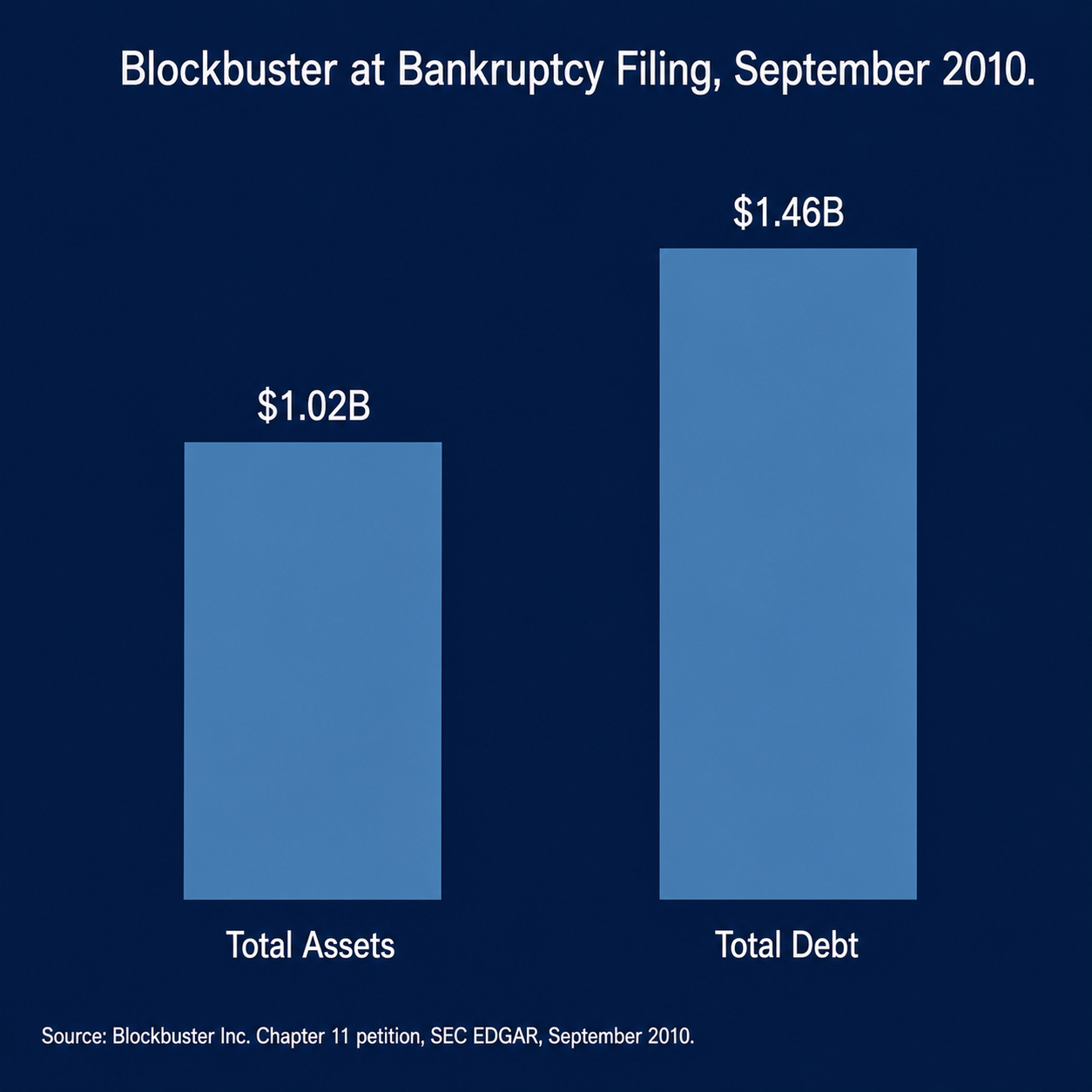
Creditor negotiations began in 2009. The bankruptcy petition was filed on September 23, 2010, listing assets of $1.02 billion against debt of $1.46 billion. Dish Network acquired Blockbuster out of the bankruptcy proceedings in April 2011 for approximately $320 million. Remaining corporate stores closed through 2013 and 2014.
The compression point — the moment at which the available option set became unresolvable — was not 2010. It was 2007, when the board restructured Total Access and the balance sheet lost the capacity to restore it. The bankruptcy was the administrative resolution of a structural position that had become unresolvable two years before the filing.
It is worth holding this sequence precisely. Total Access was launched in late 2006. It reached 3.6 million subscribers by mid-2007. Netflix’s own filings acknowledged that Blockbuster’s competitive response was slowing its growth. The program was restructured in the second half of 2007 under board pressure driven by near-term profitability concerns. Netflix’s growth resumed. Blockbuster filed for bankruptcy in 2010.
The sequence matters because it locates where the story actually ends. Not at the filing. Not at the Netflix launch. At the moment in 2007 when the one program generating competitive traction was pulled back, and the balance sheet had already lost the capacity to restore it.
What Blockbuster Left Behind
Three framings of this story circulate widely and each of them is wrong in a specific way.
The first is that Blockbuster failed to see Netflix coming. The record does not support this. Blockbuster launched its own online subscription service in 2004. It eliminated late fees in 2005 in direct response to the competitive disadvantage Netflix had built its brand around. It launched Total Access in 2006 as a hybrid response designed around the one structural advantage Netflix could not replicate. The company understood the threat. It built a response. The response was working.
The second is that Blockbuster was too slow to adapt. The timeline runs in the other direction. Total Access launched less than a decade after Netflix. It reached competitive parity — and by Netflix’s own account, competitive advantage — within months. The constraint was not pace. It was capital.
The third is that this was a story about technological disruption. Streaming did not end Blockbuster. Netflix’s instant-watching feature launched in January 2007 with a catalog of around 6,000 titles and was available only on personal computers. What ended Blockbuster’s ability to compete was a balance sheet obligation incurred in 2004 that consumed the capital every subsequent competitive response required.
What the market lost when Blockbuster exited was not simply a retail category. A viable hybrid rental model — one that combined the convenience of mail subscription with the immediacy of physical exchange — was extinguished before it could demonstrate whether it could have sustained competitive pressure on Netflix over the longer term. That question was not answered by the market. It was foreclosed by a capital structure.
The store in Bend, Oregon that remains open today operates as it always has — late fees and all. It is, among other things, a reminder that the model itself was not the problem. The problem was what it cost to transform it, and what had already been spent before the transformation began.
Deliberate Drift analyzes how structural positions accumulate over time — decisions that appear rational while constraints build beneath the surface, or advantages that appear ordinary while they compound into something durable.